Launch offer — valid today only

📄 Digital book in PDF · read it on your phone or print it

OBD-II Trouble Codes and Live Data in Drawings The Code, the Test, the Part: One Page Each

Test before you replace. Lean codes, misfires, O2 sensors and the catalyst, EVAP leaks, the CAN network: each one on its own page, with the drawing, the test to run and the normal value to compare. 63 illustrated pages.

TEST BEFORE YOU REPLACE

🔒 Secure checkout · PDF by email · 30-day guarantee

Every topic, its own pageEach code family's test drawn, with the normal values right beside it
63 illustrated pages9 parts, from reading the code to the bench checklists
Up-to-date sourcesSAE J2012 code definitions and EPA OBD-II rules (40 CFR Part 86)
PDF by emailFormat

Look Inside the Book

Every page has one big drawing and a box with the normal values and test steps you need to know:

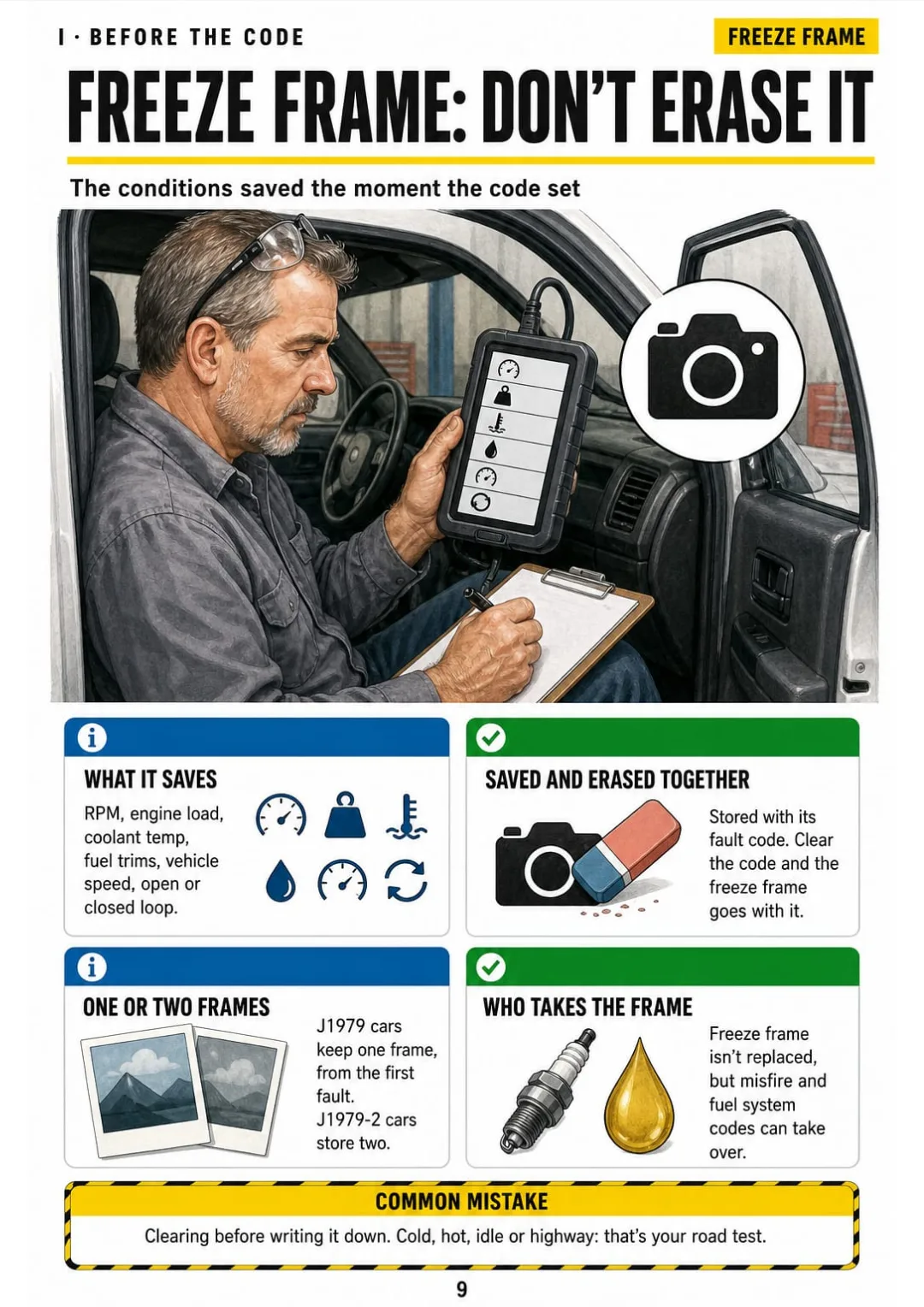
RPM, load, coolant temp, fuel trims, speed, loop: write it down before you clear
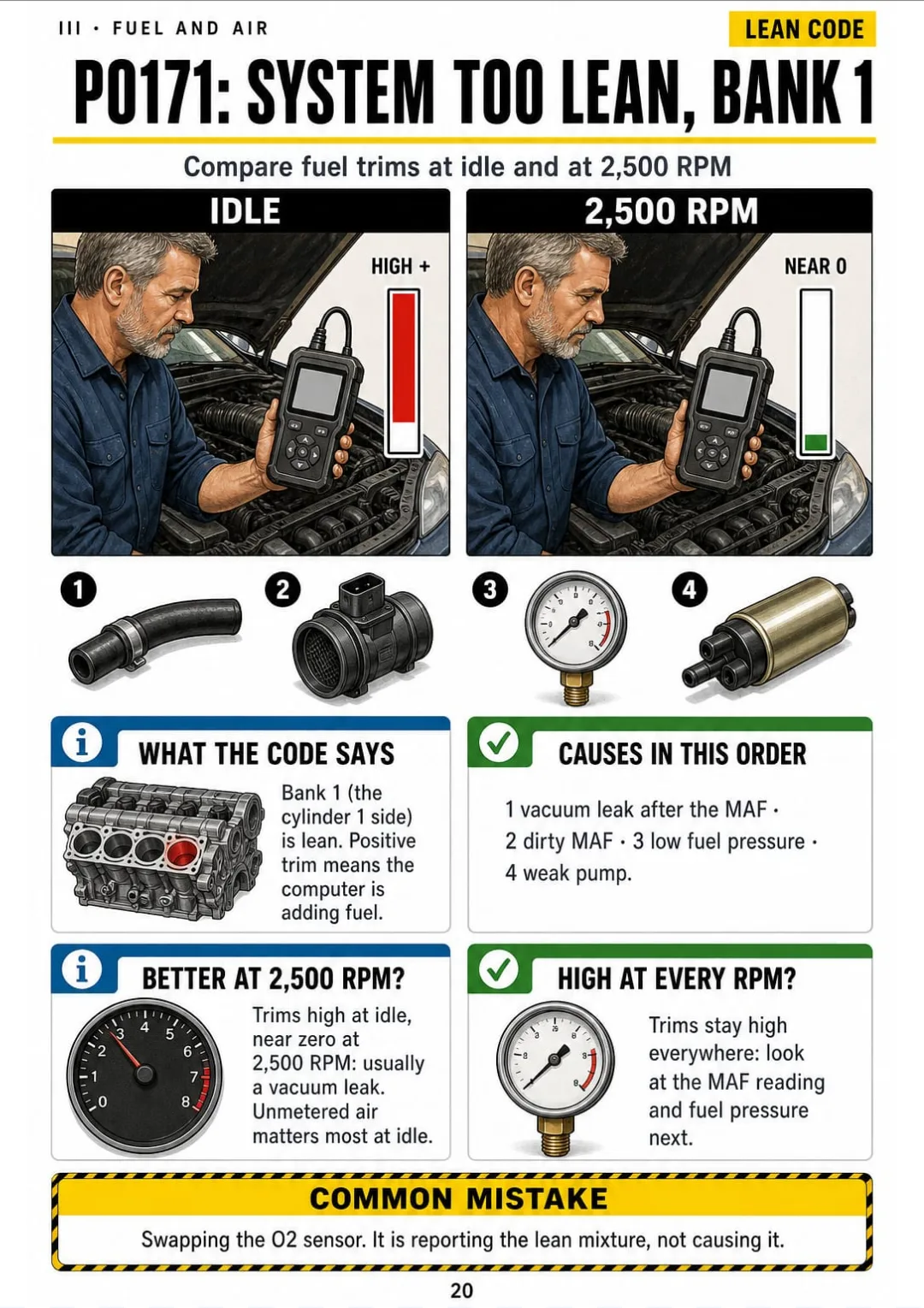
P0171: trims high at idle but near zero at 2,500 RPM usually point to a vacuum leak.
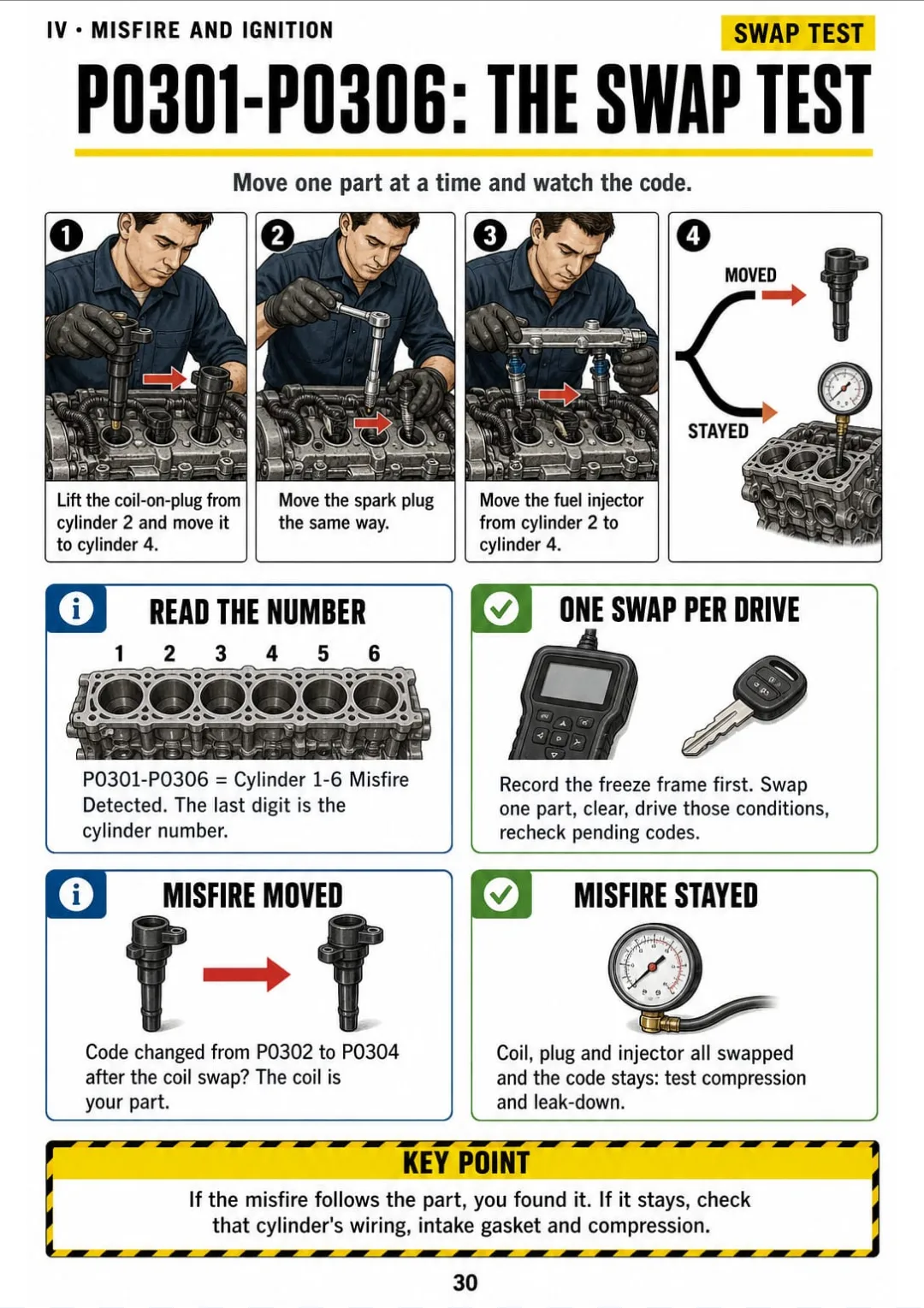
Swap test: move coil, then plug, then injector — the misfire follows the bad part or stays with the cylinder.
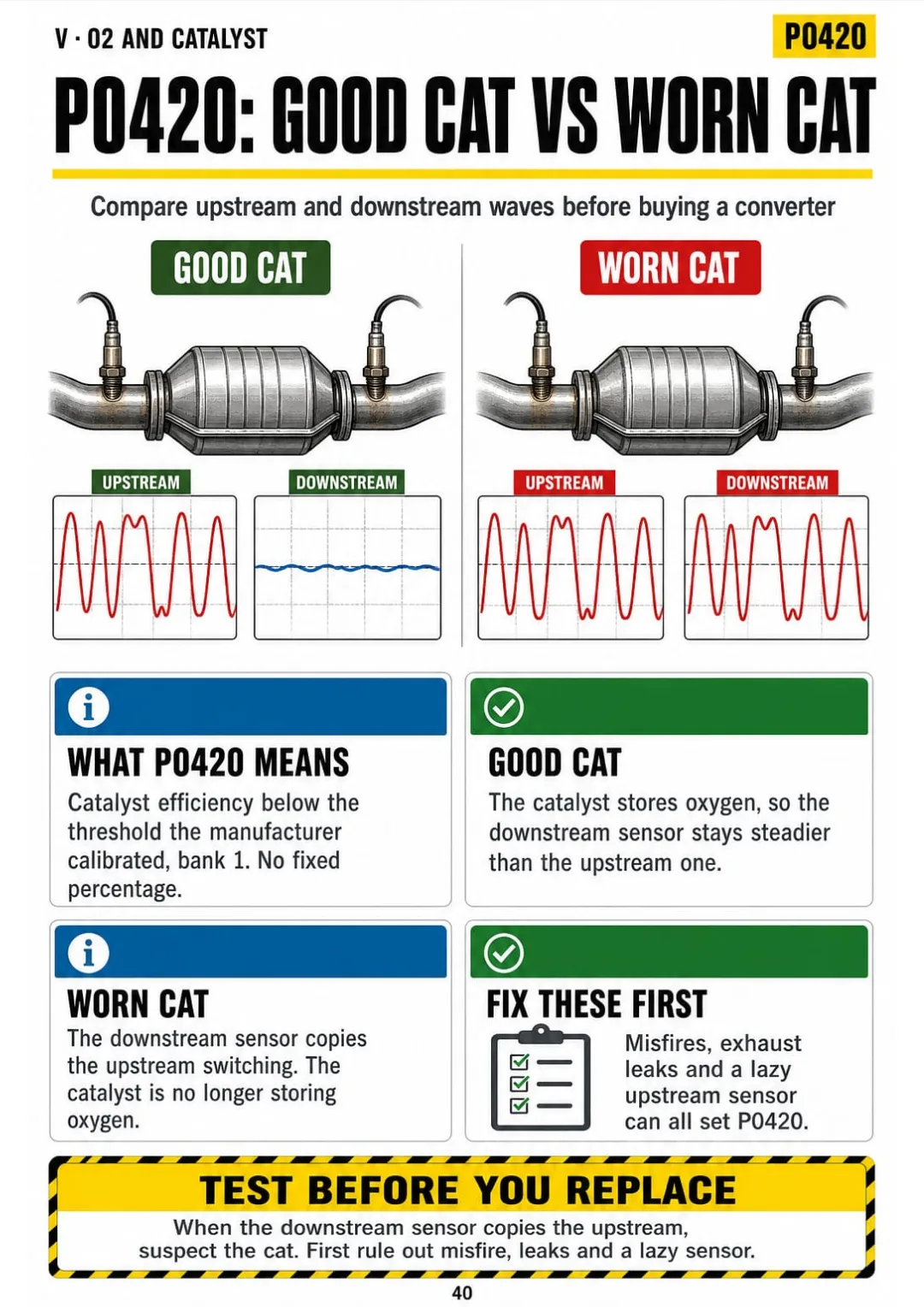
P0420: downstream steady means a good cat; downstream copying upstream means a worn cat.
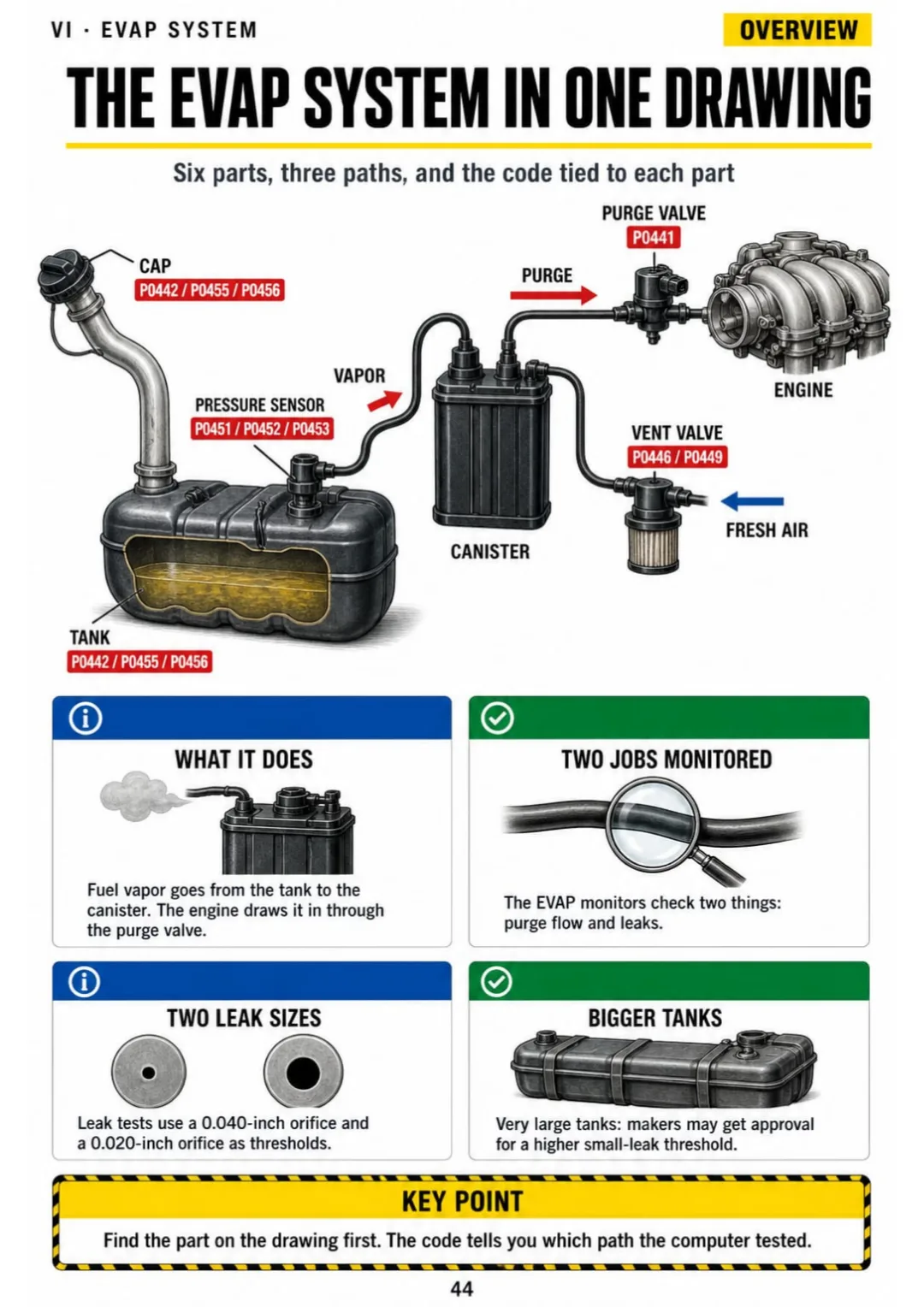
Tank, cap, canister, purge and vent valves: each part with its code
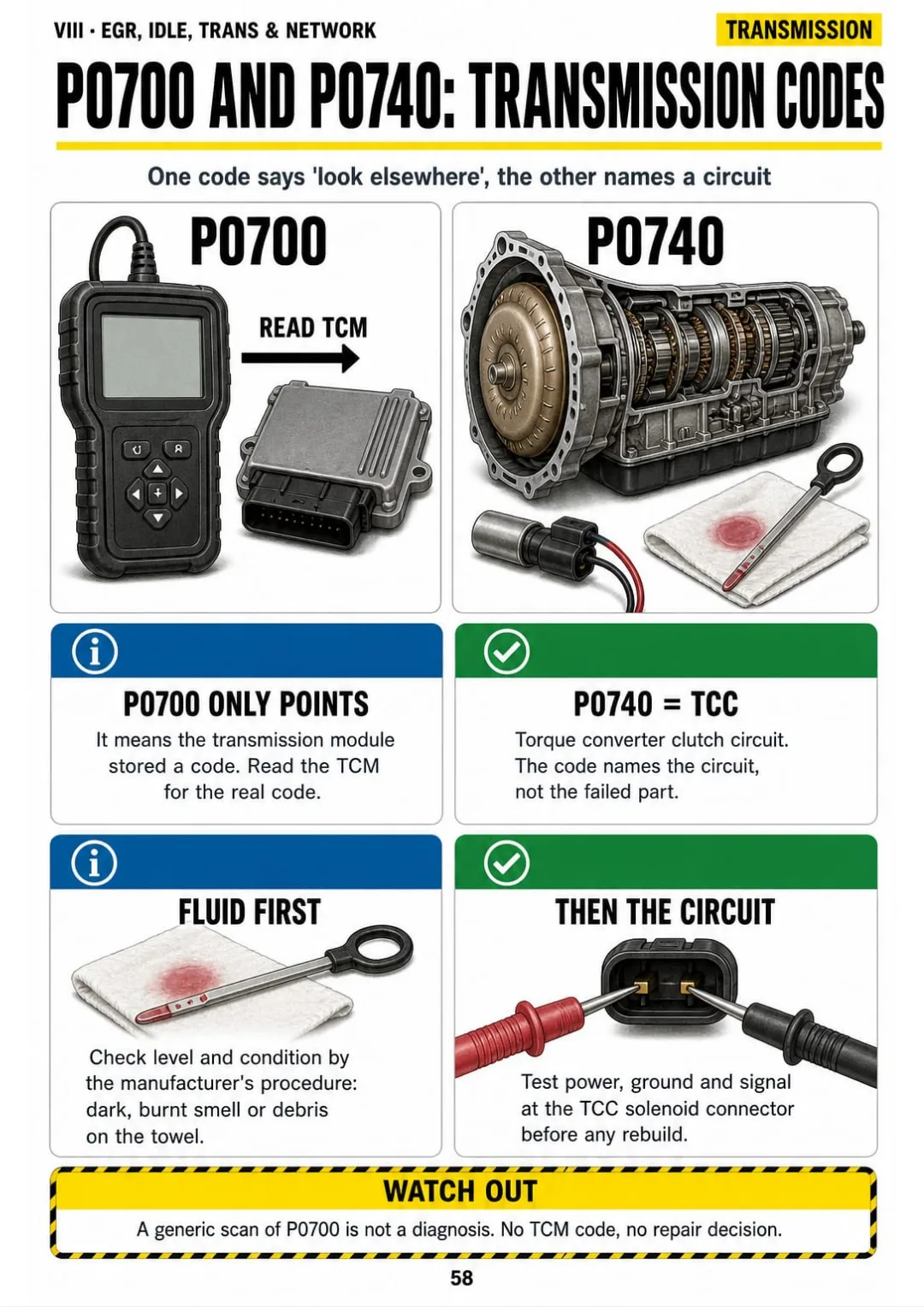
P0700: read the TCM. P0740: fluid and TCC solenoid circuit before you rebuild.
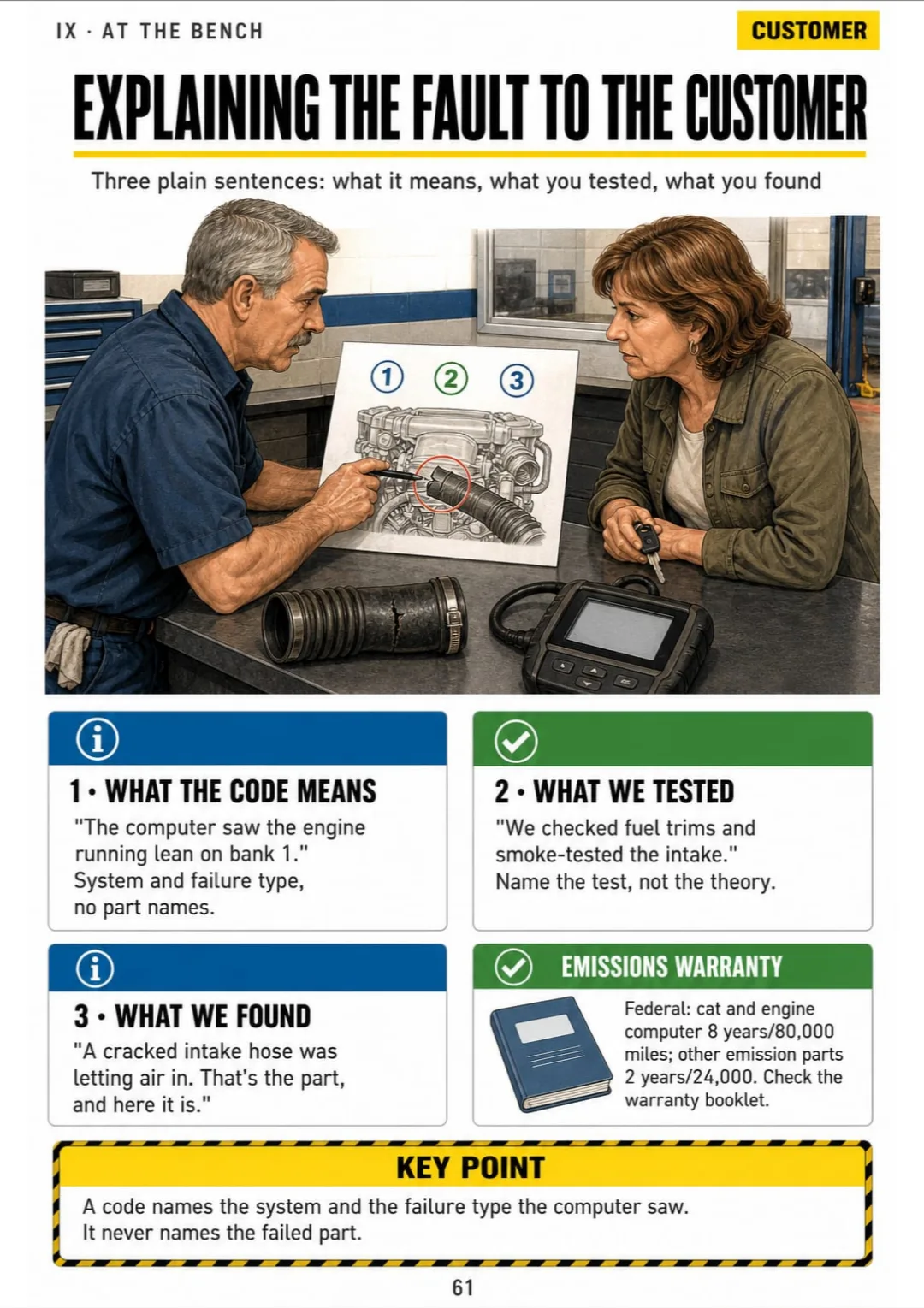
Code meaning, test done, part found: the fault in three sentences the customer understands.
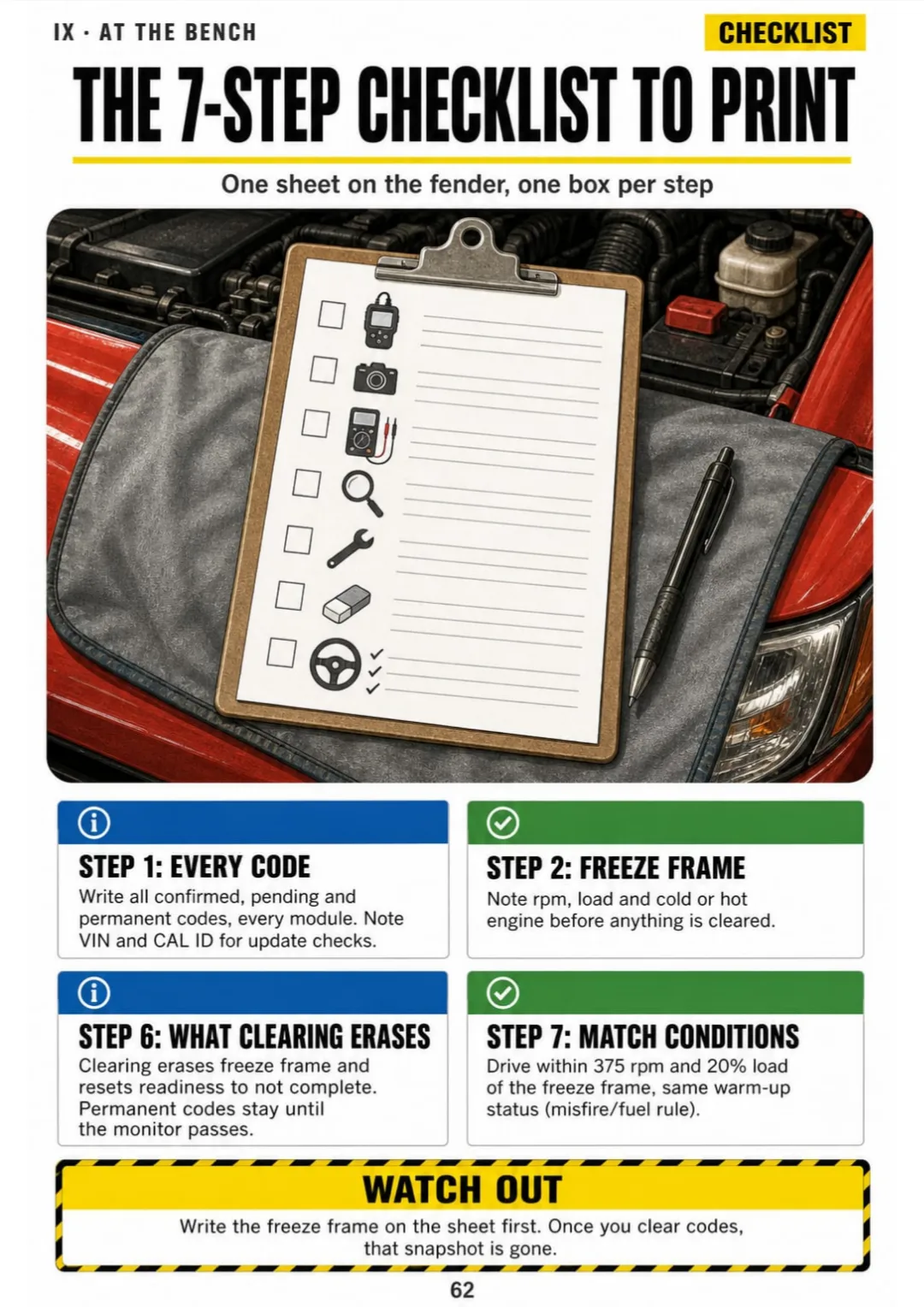
Codes, freeze frame, test, confirm, repair, clear, road test and monitors on one sheet.

Swipe to see more →

These are real pages from the book. The table of contents is the full one: 9 parts and 59 topics.

The Problem Isn't You. It's How It Was Explained to You.

You're under the hood with a misfire code on cylinder 3. Coil, plug or injector? You get one shot before the customer pays for a guess.

The manual gives you two paragraphs on crankshaft speed and misfire detection. Nothing tells you what to move first, or what it means when the misfire moves with it.

Swap test: move coil, then plug, then injector — the misfire follows the bad part or stays with the cylinder.

In the book, the swap test is one page: the coil goes to the next cylinder, then the plug, then the injector, all drawn with arrows. If the misfire follows the part, it's the part. If it stays with the cylinder, you test compression.

Same with fuel trims at idle and at 2,500 rpm, the good cat vs worn cat traces, the EVAP system and the CAN bus check: each one on its own page.

You look at the page and you know the next move, without going back to the manual or another forum thread.

COMPARE FOR YOURSELF

Same Topic, Two Ways to Learn It

THIS
  • The manual: line after line
  • Fuel trims explained only in words
  • You get to the car still unsure
P0171 is set when the powertrain control module determines that the combined short-term and long-term fuel trim corrections for bank 1 have exceeded the calibrated rich-correction threshold for a specified period, indicating that the air/fuel mixture is leaner than commanded. Possible causes include unmetered air entering downstream of the mass airflow sensor, restricted fuel delivery, contaminated sensing elements and exhaust leaks upstream of the oxygen sensor. Diagnosis should include evaluation of fuel trim behavior under varying engine load and speed conditions.
FOR THIS
  • The lean code in one drawing
  • The trims and the rpm in a box
  • You see it and you get it
P0171: trims high at idle but near zero at 2,500 RPM usually point to a vacuum leak.
CONTENTS

Take a Look at the 9 Parts and 59 Topics

Before the code, the 7-step method, fuel and air, misfire and ignition, O2 sensors and catalyst, EVAP, sensors and electrical, EGR to network, and the bench checklists: 63 pages, all illustrated.

IBefore You Read the Code · pp. 5-12
  1. How to read a trouble code
  2. The third digit tells you where to look
  3. The 16-pin connector, pin by pin
  4. Pending, confirmed, permanent
  5. Freeze frame: the snapshot you erase by mistake
  6. Fuel trims in one picture
  7. Readiness monitors: continuous and non-continuous
  8. Mode $06: the test results nobody looks at
IIThe 7-Step Method · pp. 13-19
  1. The 7 steps on one page
  2. Step 1: Read every code, not just the first
  3. Step 2: Use the freeze frame
  4. Step 3: Test power, ground and signal
  5. Step 4: Confirm before you buy
  6. Steps 5 and 6: Repair, then clear
  7. Step 7: The road test that closes the job
IIIFuel and Air Codes · pp. 20-28
  1. P0171: System too lean, bank 1
  2. P0174: System too lean, bank 2
  3. P0172: System too rich, bank 1
  4. P0101: MAF range/performance
  5. P0102 and P0103: MAF circuit low and high
  6. P0106: MAP range/performance
  7. P0113: Intake air temp high input
  8. P0087: Fuel rail pressure too low
  9. P0201-P0206: Injector circuit
IVMisfire and Ignition · pp. 29-35
  1. P0300: Random misfire
  2. P0301-P0306: Misfire on one cylinder
  3. Compression and leak-down for a misfire that stays
  4. Ignition coil: good and bad pattern
  5. P0335: Crankshaft position sensor
  6. P0340: Camshaft position sensor
  7. P0016: Crank/cam correlation
VOxygen Sensors and Catalyst · pp. 36-43
  1. How a narrowband O2 sensor switches
  2. Air/fuel ratio sensor: lambda, not volts
  3. P0130-P0134: O2 sensor circuit bank 1 sensor 1
  4. P0135 and P0141: O2 heater circuit
  5. P0420: Catalyst efficiency below threshold
  6. Why a new cat brings P0420 back
  7. Exhaust leaks that fake O2 codes
  8. P0430 and bank 2 codes
VIEVAP System · pp. 44-48
  1. The EVAP system in one drawing
  2. P0455 and P0442: Large and small leak
  3. P0456: Very small leak
  4. P0441: Incorrect purge flow
  5. P0446 and P0449: Vent valve
VIISensors, Temperature and Electrical · pp. 49-55
  1. P0128: Coolant below thermostat temperature
  2. P0117 and P0118: Coolant temp sensor circuit
  3. P0122 and P0123: Throttle position sensor
  4. P0325: Knock sensor circuit
  5. P0500: Vehicle speed sensor
  6. P0562: System voltage low
  7. Voltage drop on power and ground
VIIIEGR, Idle, Transmission and Network · pp. 56-59
  1. P0401: EGR insufficient flow
  2. P0505 and P0507: Idle control
  3. P0700 and P0740: Transmission codes
  4. P0606 and U0100: Computer and network
IXAt the Bench: Review and Checklists · pp. 60-63
  1. The parts people replace for nothing
  2. Explaining the fault to the customer
  3. The 7-step checklist to print
  4. Normal values at a glance

One Page, One Topic, All Clear

Think of it this way:

A car comes in with a lean code. The freeze frame says warm engine, at idle. You need to know if it's a vacuum leak or the airflow sensor before you order anything.

You open the lean code page and see the trims drawn at idle and at 2,500 rpm: high at idle and near zero up top points to a vacuum leak. The part you were about to buy stays on the shelf.

Tank, cap, canister, purge and vent valves: each part with its code

Same with the misfire swap test, the good cat vs worn cat traces, the EVAP system and the 16-pin connector: each one on its own page.

OBD Trouble Codes Illustrated is 9 parts and 59 topics, all drawn, and it closes with a 7-step checklist to print and the normal values at a glance.

What you see drawn, you don't have to memorize.

What's Inside OBD Trouble Codes Illustrated:

Ipp. 5-12

Before You Read the Code

What the scan tool is really telling you: how a code is built, the third digit, the 16-pin connector, pending vs confirmed vs permanent, freeze frame, fuel trims, readiness monitors and Mode 6 results.

IIpp. 13-19

The 7-Step Method

The 7 steps on one page, then each step on its own: every code, freeze frame, power-ground-signal, confirm, repair, clear and the road test.

IIIpp. 20-28

Fuel and Air Codes

Lean and rich codes, MAF and MAP, intake air temp, low fuel rail pressure and injector circuits.

IVpp. 29-35

Misfire and Ignition

Find the real cause of a misfire before you buy a part: random vs single-cylinder misfires, the swap test, compression and leak-down, coil patterns, crank and cam sensors and their correlation.

Vpp. 36-43

Oxygen Sensors and Catalyst

Know if the cat is really worn before it gets replaced: narrowband O2 switching, air/fuel ratio sensors, O2 circuit and heater codes, catalyst efficiency, why a new cat brings the code back and exhaust leaks.

VIpp. 44-48

EVAP System

The EVAP system in one drawing, large, small and very small leaks, purge flow and the vent valve.

VIIpp. 49-55

Sensors, Temperature and Electrical

Coolant temp and thermostat, throttle position, knock sensor, vehicle speed, low system voltage and voltage drop.

VIIIpp. 56-59

EGR, Idle, Transmission and Network

EGR flow, idle control, the basic transmission codes, the computer and the CAN network.

IXpp. 60-63

At the Bench: Review and Checklists

The parts people replace for no reason, explaining the fault to the customer, the 7-step checklist and normal values.

At the end of the book: A 7-step checklist to print and the normal values on one page.
Plus: 2 Free Books

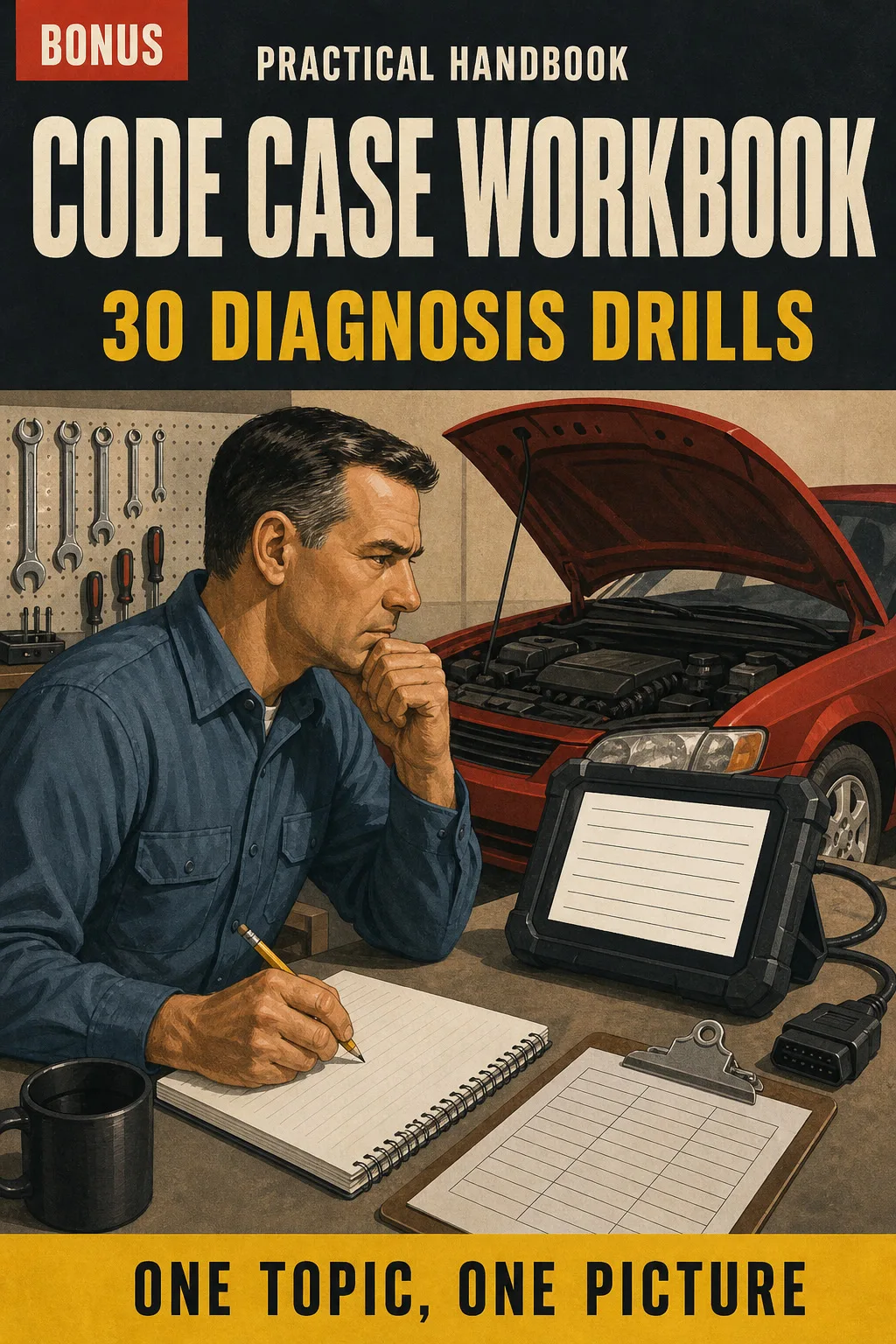
Code Case Workbook: 30 Diagnosis Drills

BONUS 1: «Code Case Workbook: 30 Diagnosis Drills»

Value on its own: US$ 17.90

Practice the 7-step method on 30 cases with the code, the freeze frame and the live data, then check your answer on the next page.

Before You Replace: Misdiagnosis Cards

BONUS 2: «Before You Replace: Misdiagnosis Cards»

Value on its own: US$ 14.90

One printable card per code group with the part people swap for nothing and the test to do first, to keep at the bench.

OBD Trouble Codes Illustrated with 2 Free Books

  • OBD Trouble Codes Illustrated: 63 illustrated pagesUS$ 63
  • BONUS 1: Code Case Workbook: 30 Diagnosis DrillsUS$ 17.90
  • BONUS 2: Before You Replace: Misdiagnosis CardsUS$ 14.90
  • High-resolution PDF to printIncluded
Total value US$ 95.80
YOUR PRICE:
US$ 27
You save US$ 68.80
YES, I WANT OBD TROUBLE CODES ILLUSTRATED FOR US$ 27

📄 This is a digital PDF book sent to your email: nothing is printed or shipped.

Secure purchaseEncrypted payment30-day guarantee

PDF by email: We email you OBD Trouble Codes Illustrated as a PDF, together with the two free books. It's a single payment: no installments, no extra charges.

Who This Book Is For

You fix your own cars

You fix your own cars

You already own a scan tool. Now every code comes with a page that tells you what to measure before you buy a part.

You're training a new tech

You're training a new tech

One method for every code, drawn, so the new guy tests before he swaps and you can point at the page.

You already work a bay

You already work a bay

Normal values, the swap test and the trims at a glance, printed and on the bench when the car won't give you a straight answer.

Everything You Get Today

US$ 95.80US$ 27
YES, I WANT OBD TROUBLE CODES ILLUSTRATED FOR US$ 27

📄 This is a digital PDF book sent to your email: nothing is printed or shipped.

30DAYS
GUARANTEE

30-Day Guarantee

Try OBD Trouble Codes Illustrated for 30 days, bonus books included.

We refund everything if the file won't open, if the book isn't what you see here, if you were charged twice or if the email doesn't arrive. Just email us.

You pay once. No subscriptions.

Frequently Asked Questions

Is it for me if I've been fixing cars for years?

Yes. It's not a beginner course: it's one method for every code, with the test to run, the normal value to compare and the part you shouldn't replace yet. It covers generic powertrain (P0) codes on cars and light trucks with OBD-II, US models from 1996 on, any make. Manufacturer-specific codes aren't included.

Where does the content come from?

Code definitions are checked against the generic list in SAE J2012, and the OBD-II background follows the EPA requirements for light-duty vehicles. Value ranges are typical: always confirm with the vehicle's service information.

Is this official material?

No. It's an independent illustrated book. It isn't published, approved or endorsed by SAE, the EPA or any manufacturer.

Does it replace training or the service manual?

No. It's a study and bench reference. It doesn't replace professional training, the manufacturer's service information or safe shop practices.

Are the practice cases from a certification exam?

No. The 30 cases in the workbook are written for this book. They aren't official questions from any exam, the book isn't ASE test prep and it doesn't come with a certificate.

When and how do I get it?

As a PDF by email, to the address you enter at checkout.

My scan tool gives me the code and I can look it up free. Why pay for this?

A free lookup tells you what the code means and lists ten possible parts. The book shows the test that picks one: the trims at idle and at 2,500 rpm, the swap test, power-ground-signal, the normal value to compare. And it's a one-time payment, no subscription.

Can I have it on paper?

Yes. The PDF prints on regular letter paper, so you can keep the pages you use most at the bench.

How does the refund work?

You have 30 days. We refund everything if the file won't open, if the book isn't what you see on this page, if you were charged twice or if the email doesn't arrive: just email us.

Before You Close This Page

No more rereading forum threads that say ten different things.

The swap test, drawn out step by step.

You get to the next car knowing where everything is.

Drawings make studying faster.

The book is right below.

One-time payment: US$ 27 · Guarantee: 30 days · PDF by email

YES, I WANT OBD TROUBLE CODES ILLUSTRATED FOR US$ 27

📄 This is a digital PDF book sent to your email: nothing is printed or shipped.